
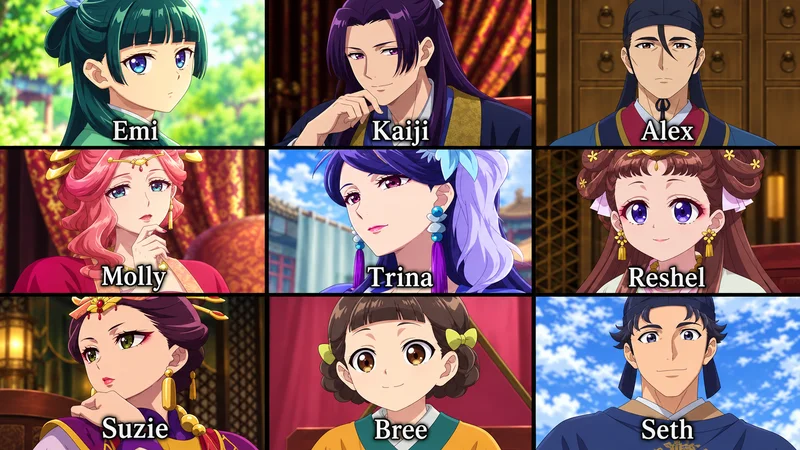
The Apothecary Diaries characters are led by Maomao, a sharp-eyed apothecary who solves mysteries inside the imperial court, and Jinshi, the beautiful palace official who keeps drawing her into trouble. Around them are Consort Gyokuyou, dependable Gaoshun, palace servants, military officers, and people connected to Maomao’s childhood. Each has a different reason to protect a secret, seek influence, or question an apparently ordinary incident.
The appeal of this cast goes beyond identifying heroes and villains. A kind consort may still be politically vulnerable, a cheerful servant may notice details an official misses, and a seemingly eccentric visitor may carry an important piece of the past. For readers exploring character guides on MangaNato, understanding those positions makes the palace mysteries much easier to follow.
This guide to The Apothecary Diaries characters introduces 16 important figures, explains what each contributes, and shows how the inner palace, outer court, and pleasure district connect. The selection is organized by narrative importance rather than popularity or strength. It includes light character information from the anime’s first two seasons but avoids revealing the biggest identity twists.
The Apothecary Diaries Characters at a Glance
Before exploring individual profiles, it helps to sort The Apothecary Diaries characters by the world they inhabit. Palace life is divided by rank and duty, so two people who speak casually to Maomao may have very different authority over her future.
- Maomao and Jinshi: The central investigative partnership, built on her medical judgment and his access to palace affairs.
- Consorts and their households: Gyokuyou, Lihua, Lishu, Ah-Duo, and Loulan live under the pressure of imperial politics.
- Servants and attendants: Gaoshun, Xiaolan, and Shisui reveal the practical routines and informal networks of the court.
- Officials and specialists: Lakan, Lihaku, Basen, and Suirei connect palace incidents to military, administrative, and medical questions.
- Maomao’s past: Luomen and Fengxian help explain the knowledge and emotional distance she brings to her work.
The list is not a power ranking. Maomao might solve a problem that an official cannot, while a relatively minor court servant may know information no senior consort would ever hear. That imbalance is part of what makes the ensemble interesting.
Eight Characters at the Heart of the Story
The first eight entries in this guide to The Apothecary Diaries characters establish the series’ everyday tension: who holds authority, who must obey, and who notices what everyone else overlooks.
1. Maomao — The Apothecary Who Solves Mysteries
Maomao is the protagonist and the reader’s most dependable guide through palace life. Raised around a pleasure district and trained in medicine by Luomen, she recognizes symptoms, ingredients, and human behavior that others misinterpret as bad luck or curses. After being brought into the rear palace as a servant, she becomes a poison taster for Consort Gyokuyou.
Her greatest strength is careful observation, but she is not an all-knowing detective. Her fascination with unusual medicines can distract her, and she often underestimates the social consequences of saying something true. Those contradictions make her memorable: she wants a quiet life, yet curiosity repeatedly carries her into situations where remaining silent is impossible.
2. Jinshi — The Charming Official with Hidden Responsibilities
Jinshi appears to oversee the rear palace, and his remarkable looks make him the subject of constant attention. Maomao’s refusal to be impressed is one reason he finds her so intriguing. He frequently asks her to examine suspicious events, creating a partnership that shifts between mutual respect, frustration, and understated humor.
Unlike Maomao, Jinshi must think about appearances as well as facts. His position gives him access to information, but it also limits what he can openly explain. Much of his appeal comes from watching a confident public figure become less composed around someone who treats him as a demanding employer rather than a celebrity.
3. Gyokuyou — The Consort Who Trusts Maomao
Gyokuyou is a high-ranking imperial consort who lives at the Jade Pavilion. Her household becomes Maomao’s first real base inside the palace after Maomao helps identify the cause of a dangerous illness. Gyokuyou appreciates ability and loyalty, making her relatively approachable compared with many other powerful figures.
That warmth should not be mistaken for political naivety. As a favored consort and mother, she understands that careless rumors or a rival household’s actions can affect the people under her protection. Her mixture of kindness, playful teasing, and practical caution gives the court a human center without erasing its risks.
4. Gaoshun — The Reliable Attendant Behind Jinshi
Gaoshun is Jinshi’s capable, long-suffering attendant. He manages sensitive tasks, watches for danger, and frequently handles the complications created when Jinshi and Maomao disagree. His calm manner makes him a useful contrast to both of them: Jinshi can become impulsive, while Maomao can follow a clue without considering how much trouble it will cause.
Gaoshun also brings a sense of family and professional duty to the story. He has obligations beyond serving one demanding official, including his relationship with his son Basen. When the plot grows tense, his measured response helps readers understand which events are merely embarrassing and which are genuinely dangerous.
5. Xiaolan — Maomao’s Friend Among the Palace Servants
Xiaolan is a cheerful servant whose friendship with Maomao provides warmth in a place governed by suspicion. She enjoys gossip and often hears news circulating among the palace workers. That might seem less impressive than Maomao’s scientific knowledge, but informal conversations are an important way information travels in a tightly controlled household.
For Maomao, Xiaolan represents something unusual: an uncomplicated friendship that is not built on an investigation or an obligation to a superior. Their conversations show how ordinary servants experience rules that wealthy residents can largely take for granted. Xiaolan’s presence also makes it clear that the rear palace contains many lives beyond the imperial family’s.
6. Lihua — A Proud Consort Marked by Grief
Lihua is the high-ranking Wise Consort of the Crystal Pavilion. Early in the story, illness and personal loss leave her household in a fragile position. Maomao’s intervention reveals how a dangerous substance, misunderstood by those around Lihua, can be mistaken for an unavoidable misfortune.
Lihua initially seems distant, but her later interactions with Maomao show gratitude and dignity. She is an important reminder that an imperial title offers status without guaranteeing safety. Her storyline treats grief seriously and illustrates why medical knowledge can matter as much as political influence in the palace.
7. Lishu — The Young Consort Facing Palace Pressure
Lishu is a younger high-ranking consort whose timid behavior makes her vulnerable to mistreatment and misunderstanding. She lacks the confidence and support that help figures such as Gyokuyou navigate court life. Her struggles reveal how rank does not necessarily protect a person from cruelty within their own household.
Maomao’s attention to Lishu is valuable because it does not depend on whether the young consort can offer something in return. Through Lishu, the story explores loneliness, social rules, and the difference between having formal authority and being able to exercise it. Her quieter scenes can be as revealing as the series’ larger mysteries.
8. Ah-Duo — A Former Consort with a Complicated History
Ah-Duo stands apart from the other consorts. She has a longstanding connection to the emperor and carries herself with a confidence that does not always fit the court’s expectations of feminine behavior. Her presence raises questions about loyalty, succession, and how the past continues to shape palace decisions.
What makes Ah-Duo compelling is the restraint of her characterization. She often knows more than she says, and her reactions can suggest emotional weight without explaining its source immediately. Readers can appreciate her as a dignified, perceptive figure without having the revelations surrounding her history spoiled in advance.
Why the Inner Palace Relationships Matter
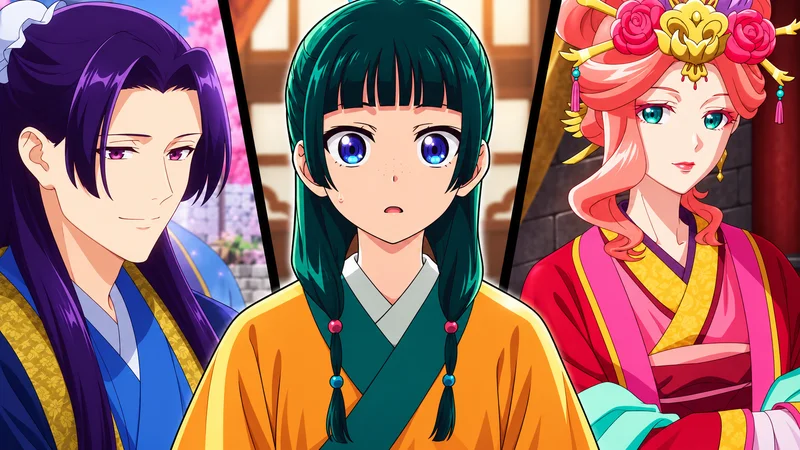
The biggest mistake when reading about The Apothecary Diaries characters is to treat everyone who lives near the emperor as though they share the same status. The rear palace is organized around rank, favor, household staff, and potential heirs. A servant’s safety may depend on the fortunes of the consort she serves, while officials outside the inner quarters influence events in less visible ways.
- Maomao and Gyokuyou: A capable servant and a consort who recognizes her usefulness and protects her within the household.
- Maomao and Jinshi: An investigator and the official who repeatedly needs her help, despite their different attitudes toward palace etiquette.
- Jinshi and Gaoshun: A sensitive working relationship built on trust, discretion, and many responsibilities.
- Consorts and ladies-in-waiting: Formal household hierarchies in which a loyal attendant may safeguard a powerful woman or endanger her.
Because the emperor has multiple consorts, some readers may ask, “what is a harem?” The historical-style imperial household in this story is a political and domestic institution, not simply the romantic comedy arrangement that the word can describe in other manga or anime. That difference helps explain why rivalry, succession, and even medicine have such serious consequences.
Eight More Characters Who Change the Story
Beyond the central households, The Apothecary Diaries characters include friends, investigators, and figures from Maomao’s earlier life. Some are easy to underestimate when they first appear, yet their knowledge or connections can redirect an entire mystery.
9. Lakan — The Unpredictable Military Strategist
Lakan is a high-ranking military tactician known for his sharp mind and fascination with games such as Go and shogi. He can be unsettling because he seems to study people as if they were pieces on a board. His interest in Maomao and the Verdigris House gradually becomes a significant part of the series’ personal history.
Rather than being merely a strange officer, Lakan forces the story to ask how much an intelligent person can misunderstand when emotions are involved. The tension surrounding him is as much about family and regret as it is about strategy. His full history is best discovered through the story itself.
10. Luomen — The Teacher Who Raised Maomao
Luomen is the apothecary who raised Maomao and taught her much of what she knows about medicines and diagnosis. His gentle manner contrasts with the harsh environments in which both of them have worked. He values evidence, careful treatment, and restraint, qualities that Maomao carries into her own investigations.
His past in imperial medical service gives him a different perspective from an ordinary neighborhood pharmacist. Even when absent from palace scenes, his influence can be felt whenever Maomao resists an easy supernatural explanation. Their relationship is one of the story’s most important emotional foundations.
11. Shisui — The Insect-Loving Palace Maid
Shisui becomes friendly with Maomao and Xiaolan after appearing among the palace servants. Her enthusiasm for insects gives her an unusual interest to share with Maomao, whose curiosity is usually directed toward medicines, poisons, and other natural substances. She is lively, observant, and not always where people expect her to be.
Shisui adds energy to the servant-side friendships, but her place in the wider plot deserves careful handling. The anime gradually builds questions around several characters introduced in the same period. A spoiler-light guide can recognize Shisui’s importance without revealing the identity-related twists connected to her storyline.
12. Suirei — A Mysterious Woman with Medical Knowledge
Suirei is a woman associated with the outer court whose knowledge of unusual medicinal practices catches Maomao’s attention. Unlike people who simply admire Maomao’s ability, Suirei can challenge her understanding and leave questions that are difficult to resolve immediately.
She matters because the series does not make every medically knowledgeable person an automatic ally. Skills can be used for different purposes, and an accurate observation does not always reveal a person’s motives. Suirei’s reserved manner and elusive appearances help turn what might seem like isolated incidents into a broader mystery.
13. Loulan — The Consort Surrounded by Questions
Loulan enters the inner palace as a high-ranking consort with an unusual public image. Her elaborate presentation and connection to an influential family make her stand out, yet appearances tell readers very little about what she actually thinks. Her household also introduces a different set of expectations and political pressures.
Loulan’s role becomes more meaningful as the series examines the limits of power inside the imperial family. Readers meeting her for the first time should pay attention to the people around her, not just her clothes or status. Explaining every connection too early would remove some of the story’s most carefully constructed suspense.
14. Lihaku — The Soldier with a Personal Stake
Lihaku is an energetic military officer who provides a less formal view of life outside the rear palace. He becomes involved in Maomao’s affairs partly through practical favors and partly through his affection for Pairin, a courtesan at the Verdigris House. His feelings create both humorous situations and a reason to take his responsibilities seriously.
He may not solve mysteries with Maomao’s precision, but his access to the military world and willingness to act make him useful. Through Lihaku, the story connects court investigations to soldiers, money, and the complicated social rules surrounding the pleasure district.
15. Basen — The Loyal but Impatient Attendant
Basen is Gaoshun’s son and serves Jinshi. He is diligent and physically capable, but his direct temperament makes him less comfortable with Maomao’s unpredictable methods. His reactions often offer a practical counterpoint to the elaborate performances required by palace life.
Basen is important because he reveals another side of Jinshi’s circle: younger retainers who have grown up around duty and loyalty but still have personal feelings and blind spots. The contrast between Basen and his calmer father also makes their family relationship easy to recognize.
16. Fengxian — A Courtesan Connected to the Past
Fengxian is a former prominent courtesan at the Verdigris House. She was respected for her intelligence and remarkable ability at Go, and her history with Lakan becomes an emotional thread in the story. Her circumstances also show how quickly a person’s position can change when illness, money, and reputation intersect.
Fengxian’s storyline is more serious than the playful atmosphere sometimes associated with the pleasure district. It gives weight to Maomao’s past and reminds readers that unresolved personal decisions can echo across many years. The most important family revelations are best left for the episodes or chapters in which they unfold.
Other Supporting Faces Worth Recognizing
These 16 profiles cover the central relationships, but The Apothecary Diaries characters extend far beyond one palace household. A few additional names are helpful when following conversations about Maomao’s childhood and the court’s daily operations.
- The Emperor: His decisions and the question of succession shape the stakes for every high-ranking consort, even when he is not the focus of a particular mystery.
- Hongniang: Gyokuyou’s capable head lady-in-waiting, who manages the Jade Pavilion’s staff and has little patience for unnecessary disruption.
- Suiren: A trusted senior attendant connected to Jinshi’s household and its practical routines.
- Pairin, Meimei, and Joka: The celebrated Three Princesses of the Verdigris House, who helped care for Maomao as she grew up.
- The Madam: The formidable manager of the Verdigris House, balancing business realities with long-established ties to its residents.
These supporting figures are not interchangeable extras. Each represents a different source of knowledge, affection, authority, or pressure that can influence what the main cast chooses to do.
Frequently Asked Questions
Who Are the Main Characters in The Apothecary Diaries?
Maomao and Jinshi are the two central figures. The wider core cast includes Gyokuyou, Gaoshun, Xiaolan, and several imperial consorts. Maomao’s medical investigations bring people from different households into the same story.
Who Is Maomao’s Closest Friend in the Palace?
Xiaolan is one of her clearest early friendships among the servants. Their bond develops through ordinary conversations rather than official duties, and Shisui later joins their social circle.
Which Consorts Should New Viewers Remember?
Gyokuyou, Lihua, Lishu, Ah-Duo, and Loulan are especially useful names to recognize. They have different relationships with the emperor, separate households, and distinct political circumstances. Not all hold the same position throughout the story.
Are Shisui and Suirei the Same Person?
No. They are introduced as different characters with distinct roles and interests. Shisui is known for her fascination with insects, while Suirei attracts attention through unusual medical knowledge. Their wider connections are best explored without jumping ahead to major spoilers.
Final Thoughts
The Apothecary Diaries characters work because the story gives each person a place in a living social system. Maomao’s curiosity and Jinshi’s influence start many of the investigations, but consorts, servants, soldiers, and people from the pleasure district provide the information and conflicts that make those mysteries matter.
For a first watch or reread, remember the character’s role before trying to memorize every hidden connection. Knowing who serves Gyokuyou, who works for Jinshi, and who belongs to Maomao’s past makes the cast much easier to follow, while leaving the bigger revelations to the story.

Adam Kan is a content editor at MangaNato with a passion for manga, manhwa, and manhua. He focuses on exploring popular series, highlighting fresh releases, and creating engaging content that helps readers discover compelling stories across different genres.